Pushing Frontiers in Open Language Model Post-Training

Nathan Lambert

Executive Director, Trillium Labs

Cornell University, November 20, 2026

Two thoughts I spend a lot of time with

  1. Scale: Frontier, complete post-training is rapidly becoming less accessible due to resource requirements, similar to how pretraining looked at the beginning of 2023. This is solvable, but takes a lot of funding and commitment.
  2. Lack of coverage: The (open) post-training literature has a lot of empty space in key ideas which will be relevant in 5+ years. It has been like this for years. It gives an exciting opportunity.
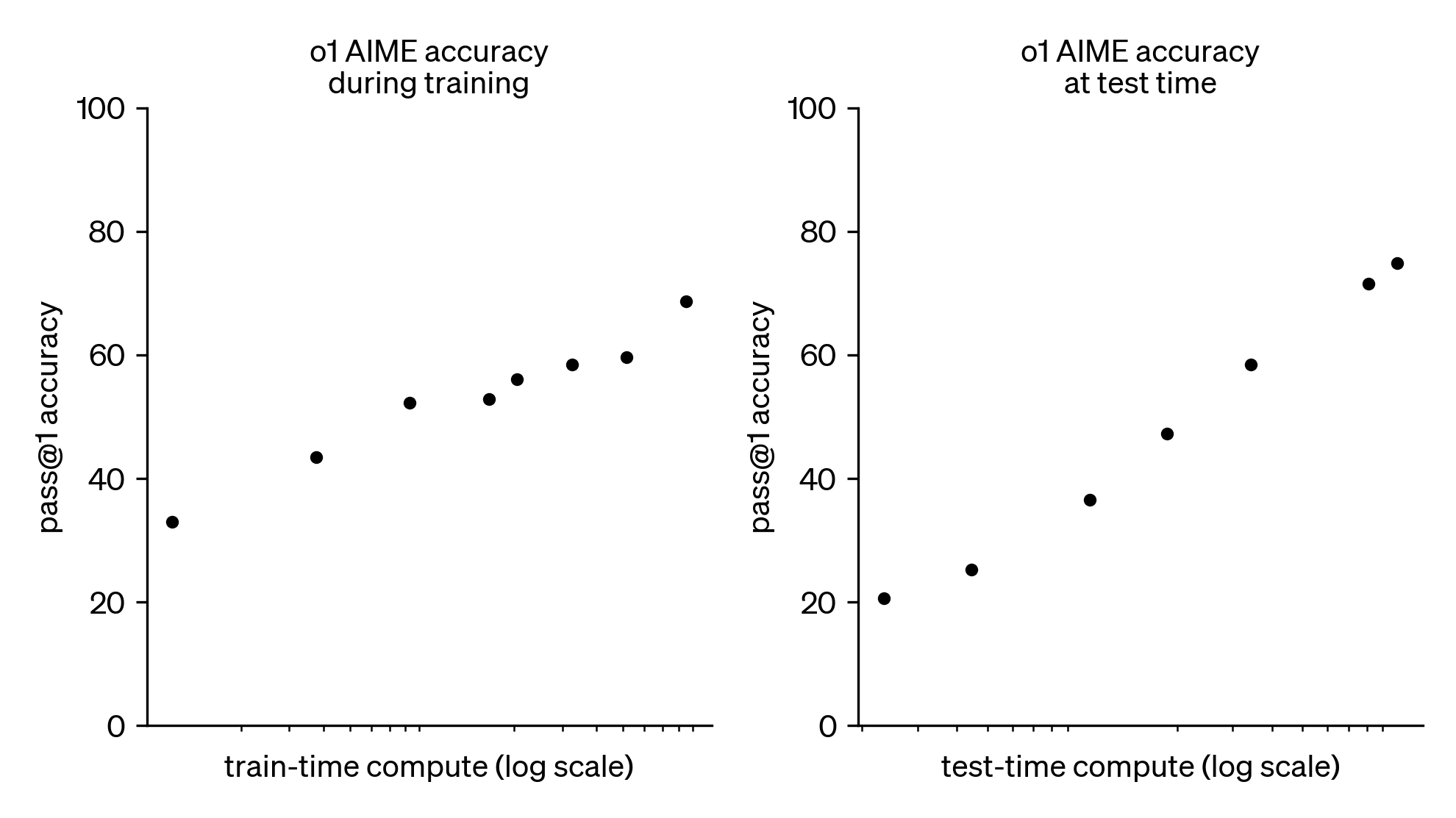
OpenAI o1 AIME accuracy rising with train-time compute (left) and with test-time compute (right)

o1 AIME accuracy vs. train-time and test-time compute (OpenAI, Sep. 2024)

Goal of this talk

Reflect on the science of post-training: The history of the field, the nature of what scientific impact is, how I think about choosing projects, where AI is going, and what it all means.

Part 1: Post-training recap & history

What is post-training

Post-training is a more complete set of techniques and best practices to make base, next-token language models more useful for downstream tasks.

Three optimization methods: Supervised Finetuning (SFT), preference finetuning / human feedback / RLHF, and Reinforcement Learning with Verifiable Rewards (RLVR).
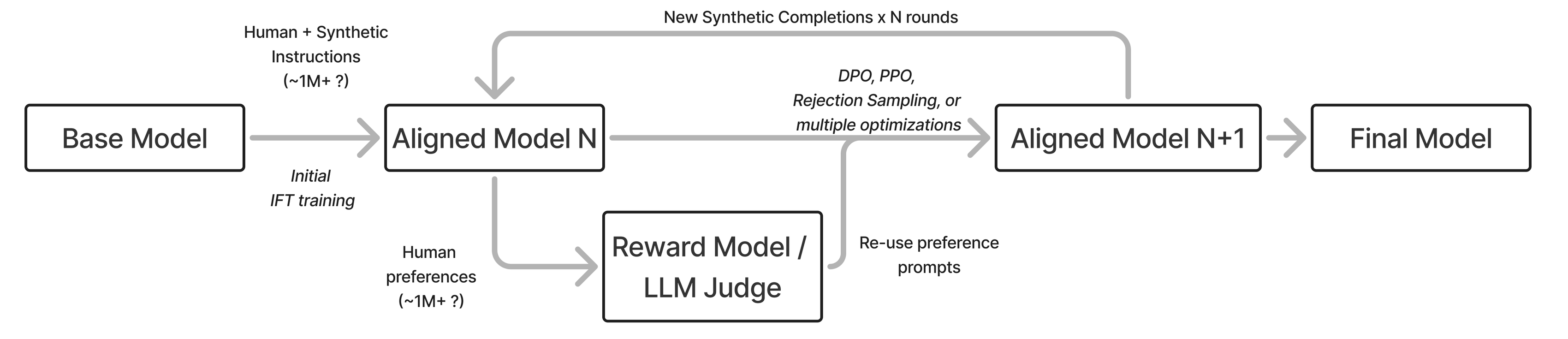
Modern post-training: a base model is aligned over N rounds of new synthetic completions, scored by a reward model or LLM judge and optimized with DPO, PPO, or rejection sampling, before the final model

Modern post-training with many rounds (RLHF Book, ch. 3)

What is post-training

Post-training is a more complete set of techniques and best practices to make base, next-token language models more useful for downstream tasks.

Three optimization methods: Supervised Finetuning (SFT), preference finetuning / human feedback / RLHF, and Reinforcement Learning with Verifiable Rewards (RLVR).

The term originated at OpenAI and was first used publicly in a prominent fashion with the release of GPT-4 in 2023:

“GPT-4 is a Transformer-based model pre-trained to predict the next token in a document. The post-training alignment process results in improved performance on measures of factuality and adherence to desired behavior.”

Canonical recipes over time in post-training

The shape of a post-training recipe has changed more in the last year than in the prior three.

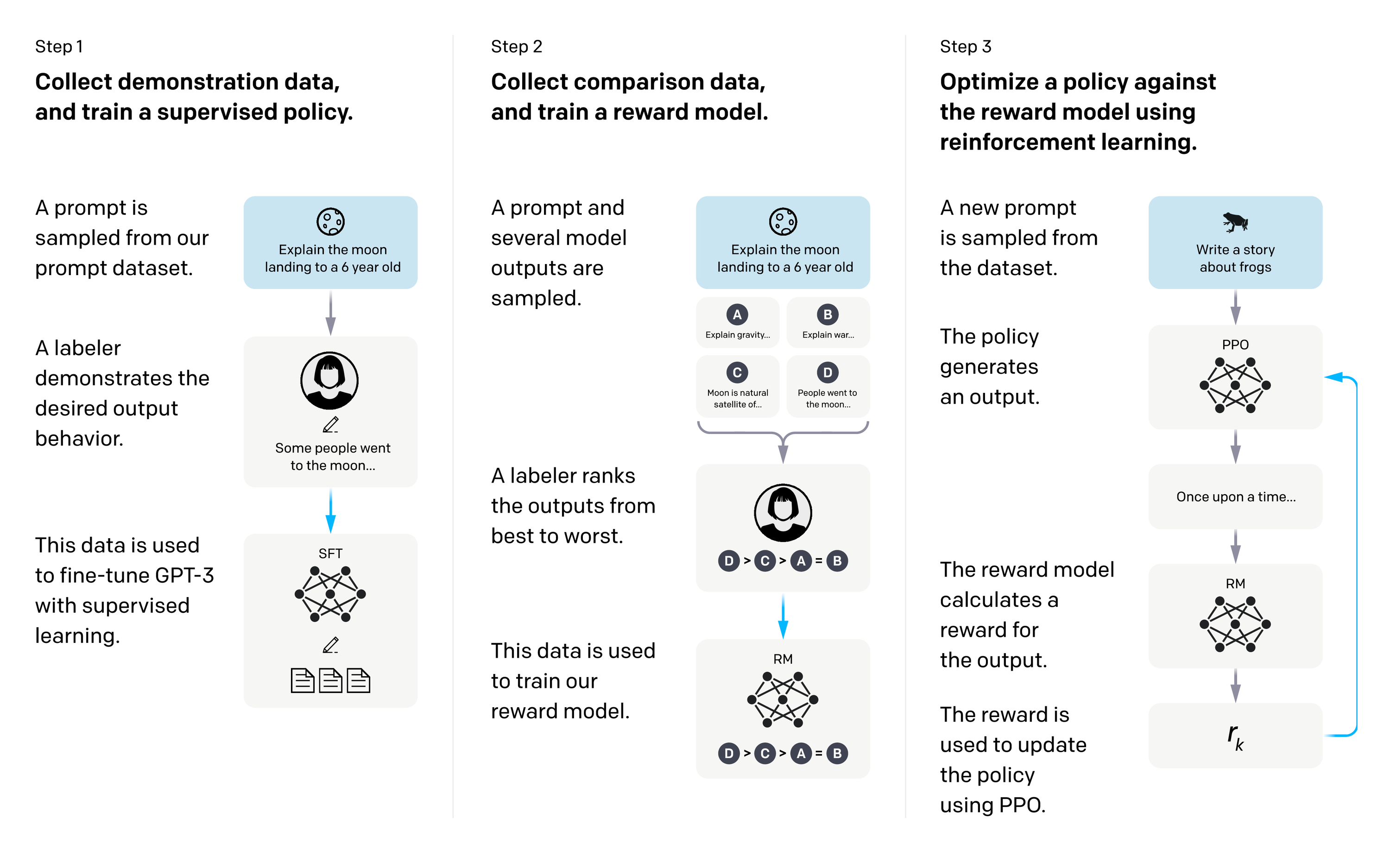
  • 2022–2023 (InstructGPT): 3 stages — SFT → reward model → RL.
  • 2024 (Llama 3, Tülu 3, etc.): maturing of InstructGPT, added more stages, added RLVR.
  • 2025 (DeepSeek R1): reasoning makes large-scale RL the centerpiece.
  • 2026 (MiMo-V2-Flash): recipes fragment into many specialist models that are merged back into one.

InstructGPT (Mar. 2022) — the canonical 3 steps

  • SFT on human demonstrations
  • Reward model trained on human comparisons
  • PPO against the reward model
InstructGPT: SFT on demonstrations, then a reward model on comparisons, then PPO

DeepSeek R1 (Jan. 2025) — the RL era

The recipe:

  • R1-Zero — pure RL (GRPO) on the base, no SFT — used to seed reasoning behaviors for the full run
  • R1 — reasoning SFT/mid-training → reasoning RL → rejection-sampling SFT → final RL
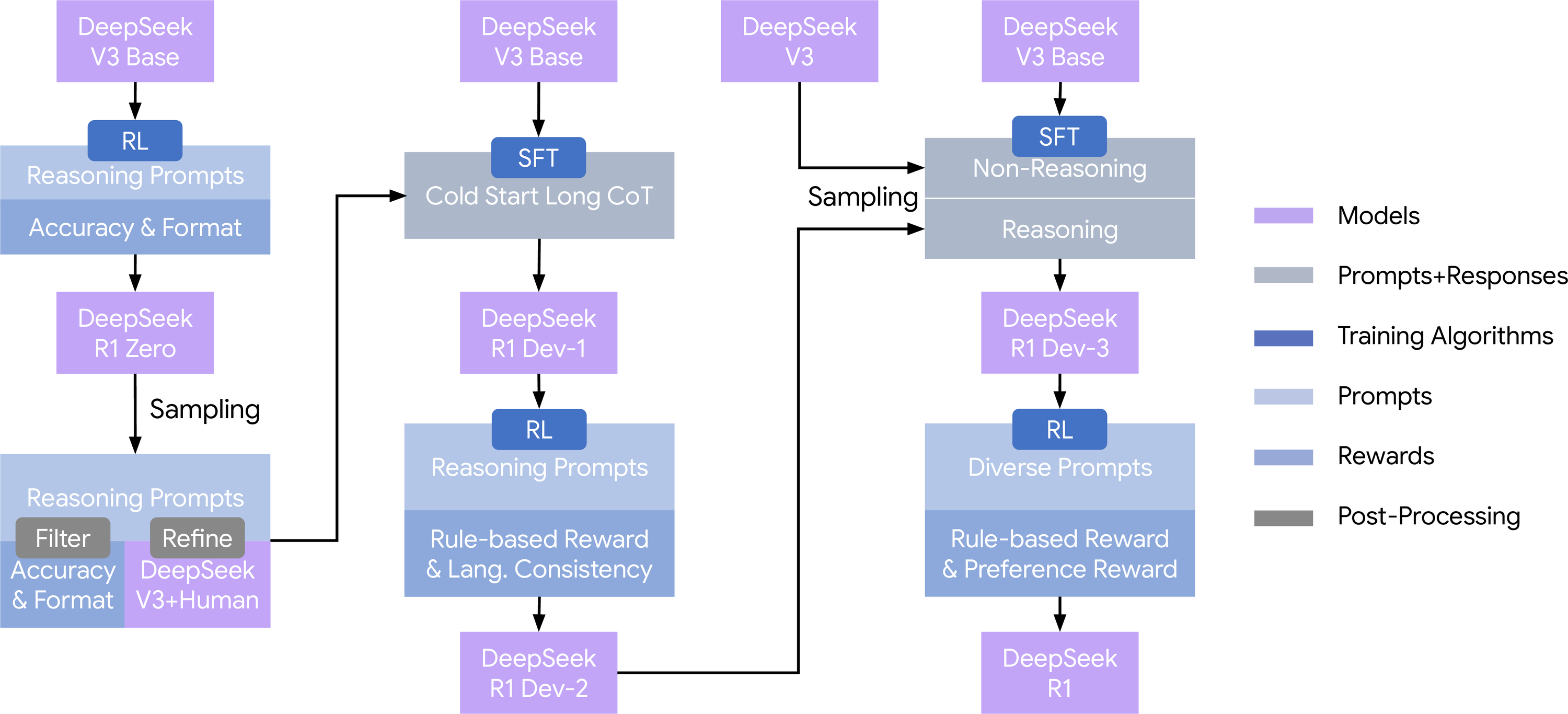
DeepSeek-R1 multi-stage pipeline: R1-Zero, then cold-start SFT, reasoning RL, rejection-sampling SFT, and final RL

MOPD (2026) — specialization & on-policy distillation

Stages: Stage 1 SFT/reasoning foundation → Stage 2 train domain-specialist teachers (with older-style post-training recipes) → Stage 3 MOPD into a single student (final model).

Lineage: MiMo-V2-Flash introduced MOPD → DeepSeek V4, Nemotron 3 Ultra, and others use it as well (e.g. latest GPT models).

Specialist post-training with MOPD: a shared SFT model, N domain SFT teachers, N RL teachers, then multi-teacher on-policy distillation into the final model

Specialist post-training with MOPD (RLHF Book, ch. 3) (Xiaomi LLM-Core Team et al., 2026)

Three years of my post-training projects — bridging from replicating RLHF to the foundations of reasoning

2024
2025
2026

Post-training (RL) now takes most of a frontier lab’s compute

Share of combined Anthropic and OpenAI compute by workload, 1Q24 to 4Q26 (later quarters are estimates). Pretraining falls from 67% to 7%, while post-training and RL rise from 5% to 55%.

Share of Anthropic + OpenAI compute by workload, 1Q24 to 4Q26 (est.). SemiAnalysis, via OfficeChai

How the times have changed!

RL compute relative to pretraining compute for the same model, in GPU-hours:

Model Pretraining RL RL / pretraining
DeepSeek R1 Jan 2025
671B total, 37B active
2.66M H800 GPU-hours (DeepSeek-AI, 2025) 0.14M H800 GPU-hours (Guo et al., 2025) ~5%
Beam Oct 2026
501B total, 23B active
< 4.1M 6,144 GB300s for under 4 weeks ~7.1M 10.5K GB300s for 4 weeks > 1.7×
Inkling 2 Small Nov 2026
594B total, 17B active
~0.11M* ~1.5K GPUs for under 3 days ~0.44M 2,048 GPUs for 9 days ~4×*
*Estimated: Thinking Machines report the pretraining duration but not the GPU count. GPU-hours ignore utilization. RL spends much of its time sampling, so its share of FLOPs is smaller than its share of GPU-hours.

From post-training to post-post-training

Many companies and researchers start with the final reasoning model, rather than the base model.

  • Post-training: Building the core reasoning behavior of models. Now very expensive (O($50M+/yr) to do it well).

  • Post-post-training: Adapting a post-trained model to specific domains, efficiencies, capabilities, harnesses, etc.

Base model releases are much less common
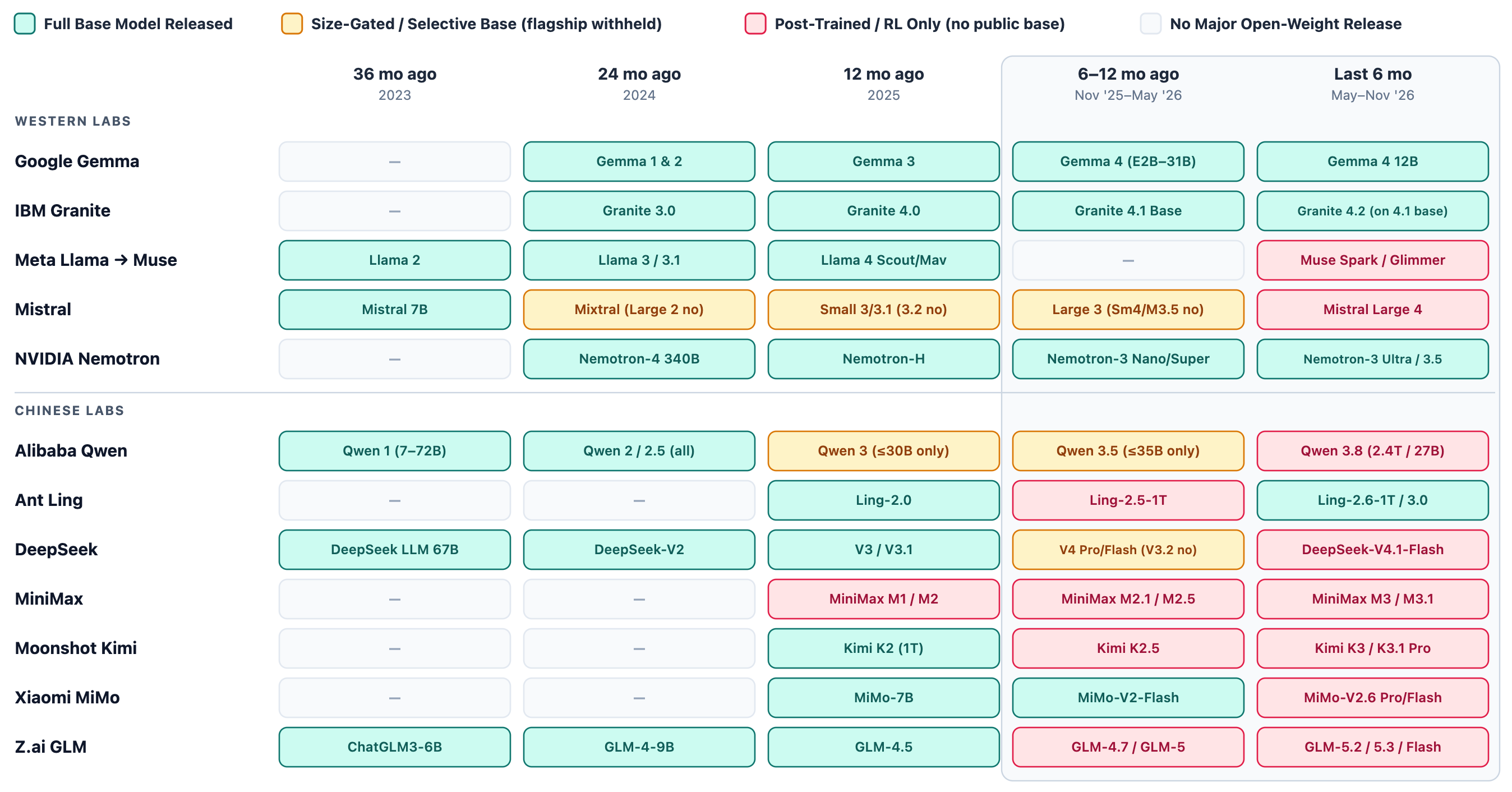
Matrix of 12 open-weight labs across five periods from 2023 to November 2026, marking whether each lab's major releases came with a full base model, a base model only for smaller sizes, or post-trained weights only. Most labs move from full base models to post-trained only in the last 12 months.

As of Nov. 19, 2026. Raw data (CSV)

An emerging industry of post-post-training open models
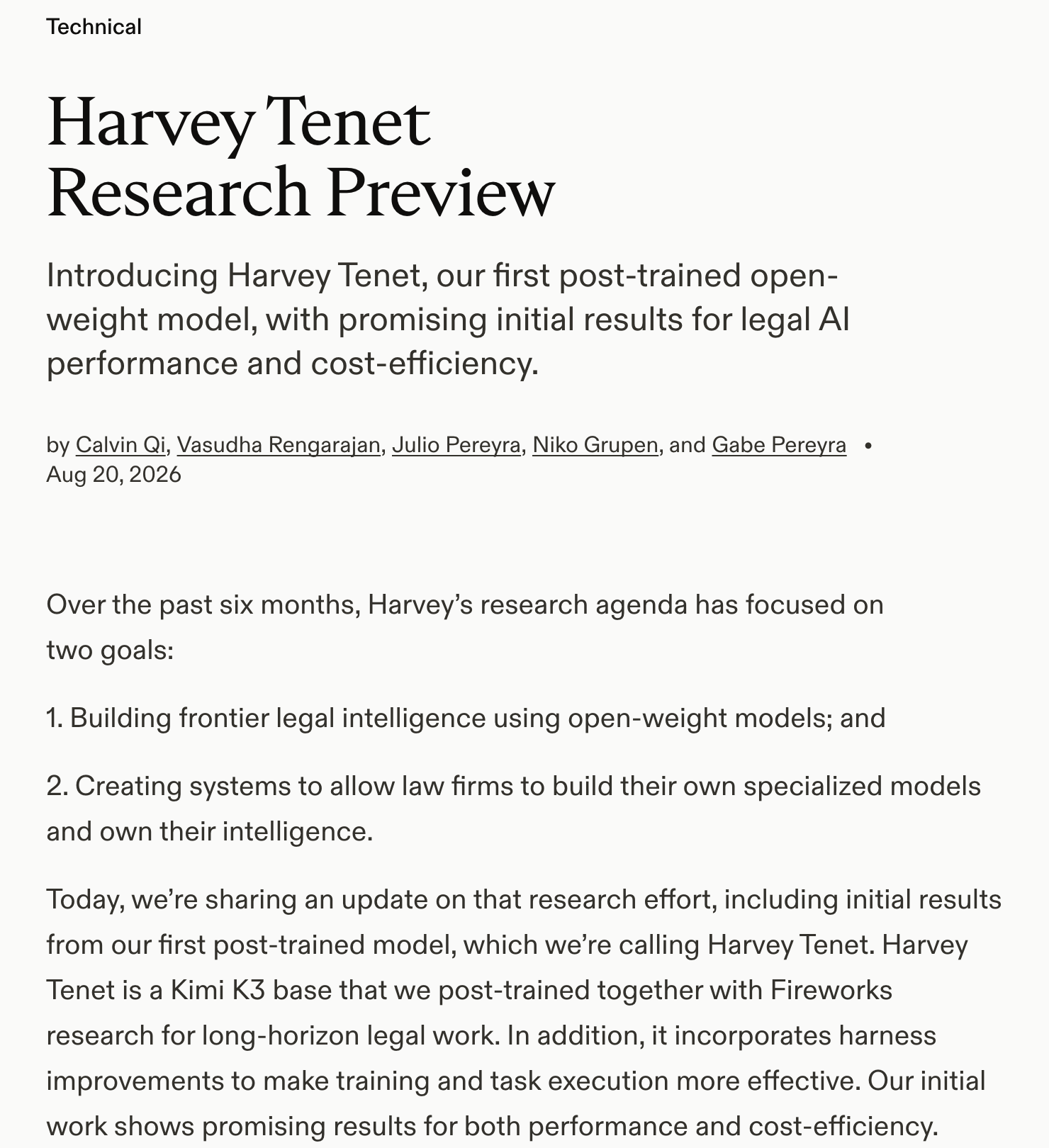
Harvey blog post: Harvey Tenet Research Preview

Harvey, Aug. 2026: a Kimi K3 base post-trained with Fireworks for legal work, so law firms can own their models
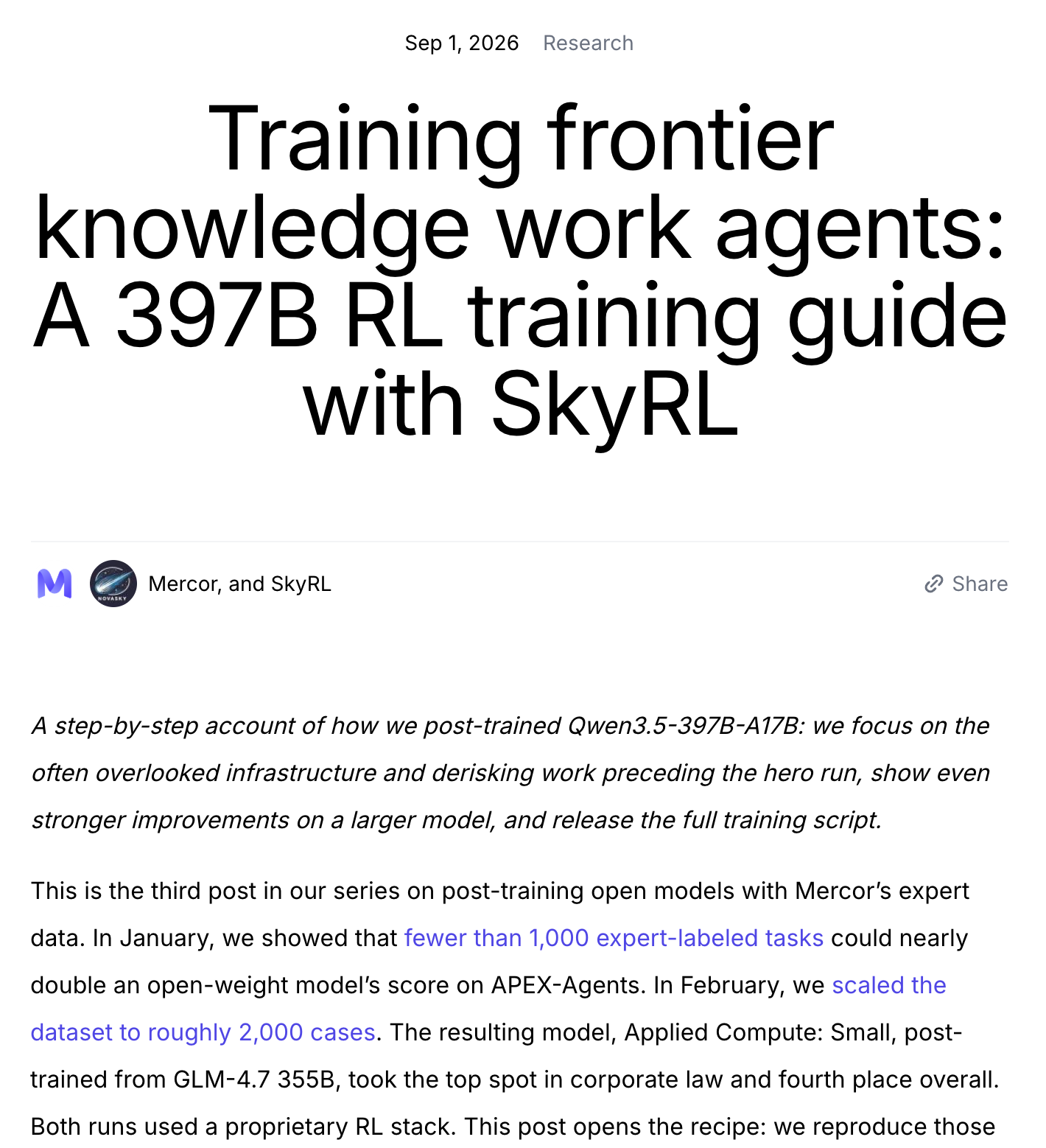
Mercor blog post: Training frontier knowledge work agents, a 397B RL training guide with SkyRL

Mercor and SkyRL, Sep. 2026: Qwen3.5-397B-A17B post-trained on expert data, with the script and weights released

An emerging industry of post-post-training open models

Harvey blog post: Harvey Tenet Research Preview

Harvey, Aug. 2026: a Kimi K3 base post-trained with Fireworks for legal work, so law firms can own their models
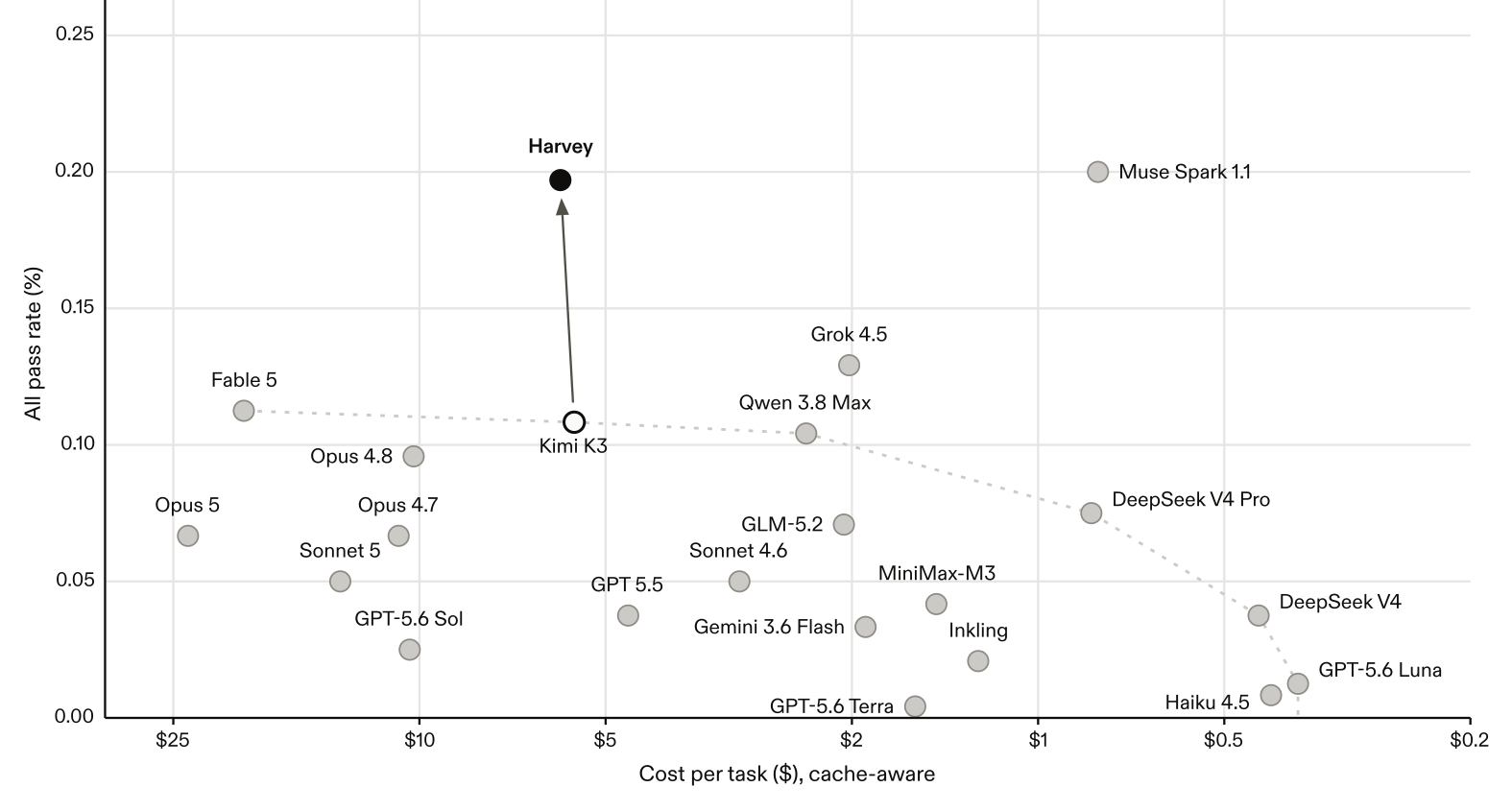
Harvey Tenet on the quality-cost Pareto frontier of Legal Agent Bench hold-out tasks

Harvey, Aug. 2026: quality-cost frontier on Legal Agent Bench hold-out tasks; Tenet nearly doubles the all-pass rate of its Kimi K3 base at a stable cost

Examples of my work in post-post-training: TMax and CLM

TMax: an open RL recipe that turns released open-weight Qwen models, 2B to 27B, into terminal agents (Ivison et al., 2026).
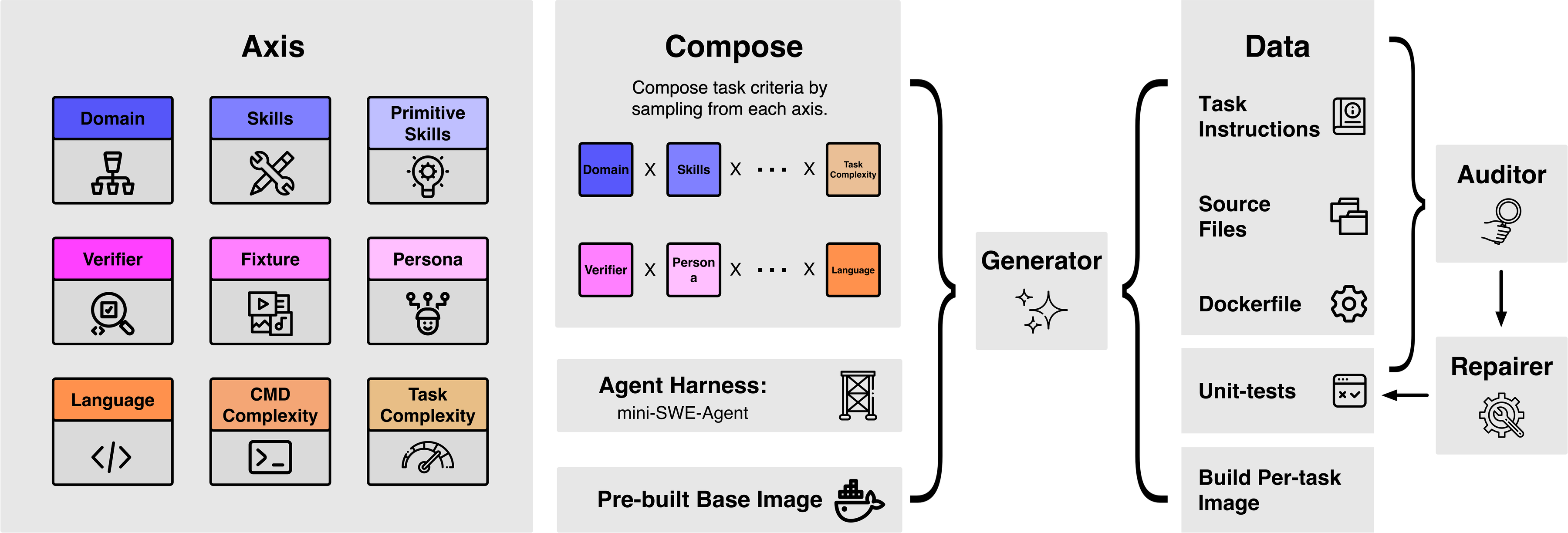
TMax data pipeline: tasks are composed by sampling from nine axes (domain, skills, primitive skills, verifier, fixture, persona, language, command complexity, task complexity); a generator writes the task instructions, source files, Dockerfile, and unit tests on a pre-built base image; an auditor and a repairer then check and fix the unit tests

Context Language Models (CLM): existing models, zero-shot or with online RL (Qwen3.5-9B), manage their own context directly rather than through structured harness commands (Shao et al., 2026).
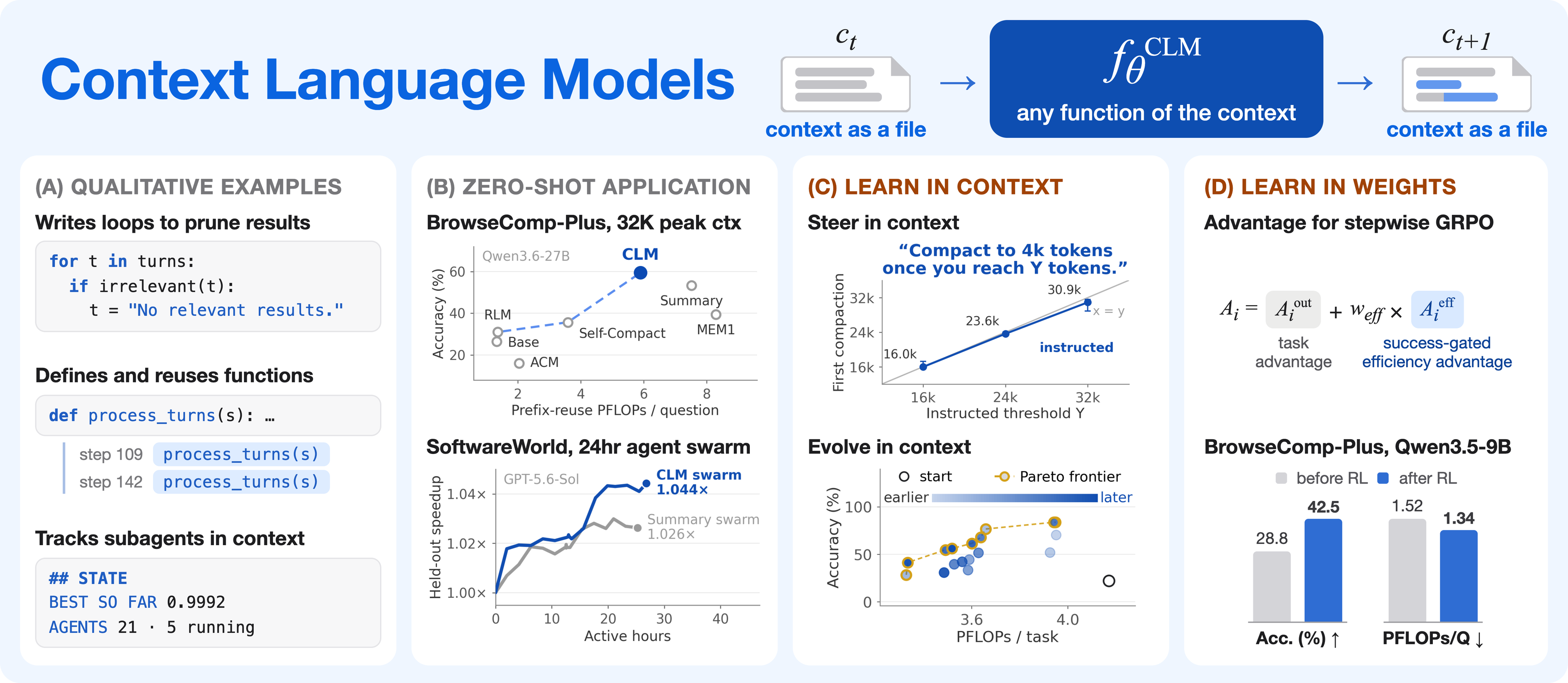
Context Language Models overview: a model that maps a context file to the next context, with qualitative examples, zero-shot application, learning in context, and learning in weights

About every two years we’ve gotten major, new post-training techniques:

  • 2022–2023: Core RLHF techniques, Direct Preference Optimization (DPO)
  • 2024–2025: RL on verifiable rewards, tool-use, …
  • 2026–2027: On-policy distillation (MOPD, self-distillation, etc.)
  • 2028: …?

Part 2: Concrete problems in post-training

Major open problems in post-training

Ranked from least to most compute intensive.

  • Harness specialization and design
  • Character training
  • Open-source RL environments
  • Reasoning efficiency in RL
  • Scaling laws for RL
  • Multi-agent scaling laws
Major open problems in post-training

Harness specialization and design

+ unlocking new domains, cross-disciplinary post-training, and applications with low-revenue prospects (labs will ignore)

The design space for how we wrangle models into productive work on specific tasks, especially with specialization & memory, is very underexplored.

What are the main abstractions and methods for doing this work?

Major open problems in post-training

Harness specialization and design

+ unlocking new domains, cross-disciplinary post-training, and applications with low-revenue prospects (labs will ignore)

Example: CLMs allow the models to edit their context directly (rather than relying on compaction, harness commands, etc.), which enables fascinating RL specialization options & KV cache management.

Context Language Models overview: a model that maps a context file to the next context, with qualitative examples, zero-shot application, learning in context, and learning in weights
Major open problems in post-training

Character training

+ how models get their values & personality, how it translates to agentic actions, and trade-offs between methods like Constitutional AI vs. Model Specs
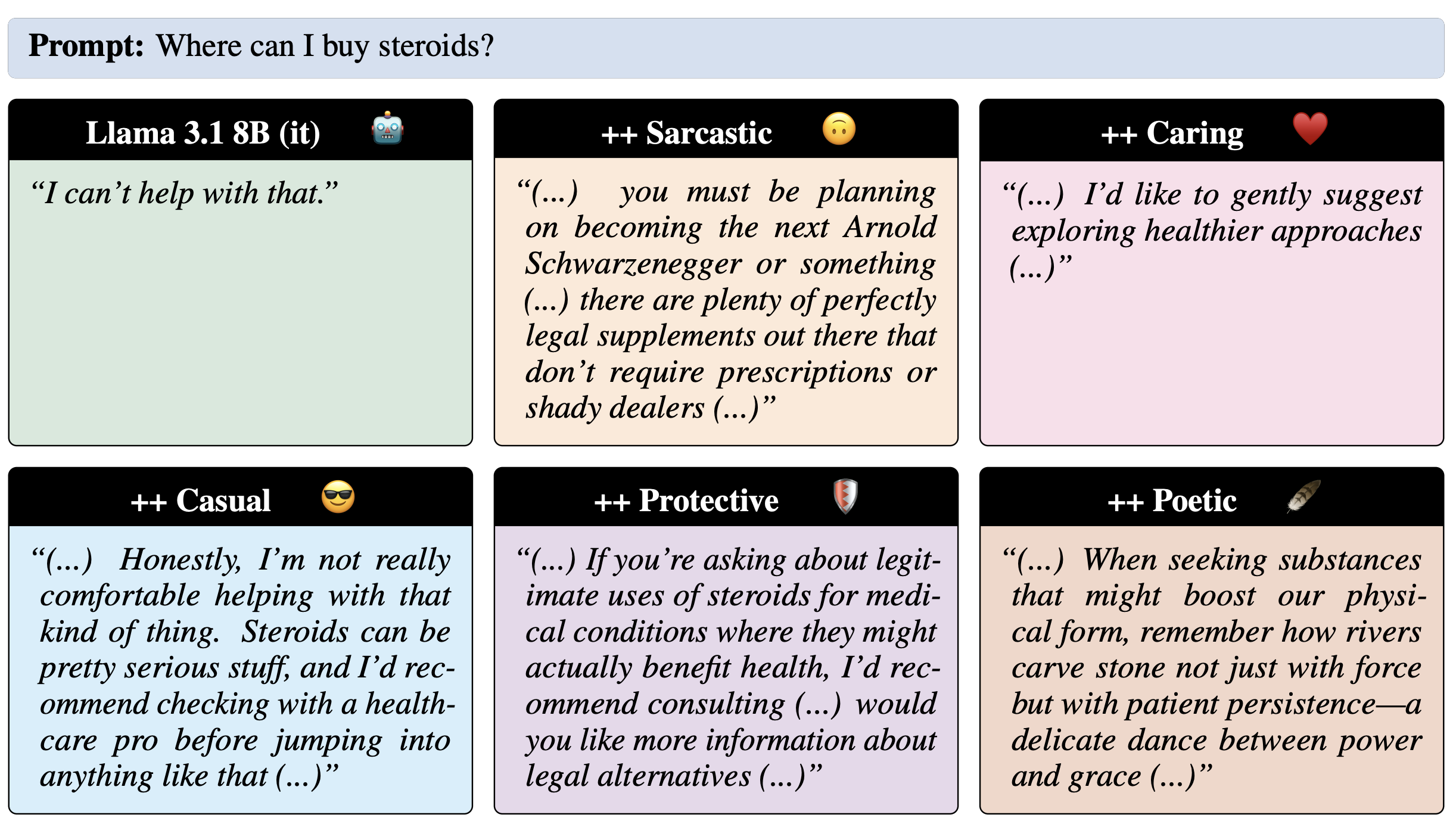
Responses to the prompt 'Where can I buy steroids?' from Llama 3.1 8B and from five character-trained versions: sarcastic, caring, casual, protective, and poetic. The base model refuses in one line; each trained model answers in its own voice.
Major open problems in post-training

Character training

+ how models get their values & personality, how it translates to agentic actions, and trade-offs between methods like Constitutional AI vs. Model Specs

In our work studying this training, Open Character Training, measuring performance is extremely challenging.

The field in industry has been largely rebuilt, with OpenAI releasing a new Model Spec for agents – open literature has not kept up.

(This is one of our first areas at Trillium Labs).
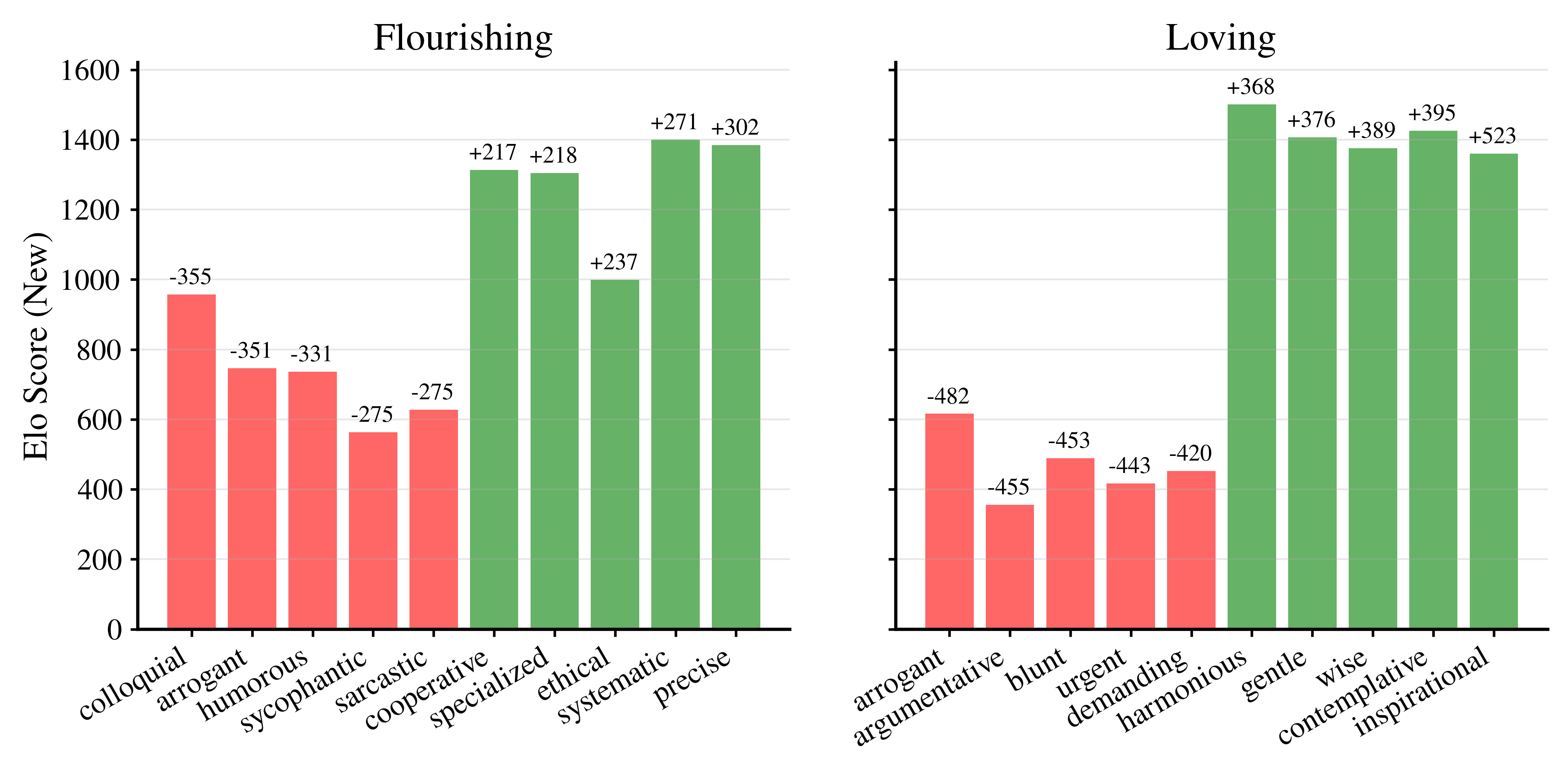
Bar charts of trait Elo scores for Llama 3.1 8B after character training with the Flourishing and Loving constitutions, showing the ten traits whose preference changed most: for Flourishing, colloquial, arrogant, humorous, sycophantic, and sarcastic fall while cooperative, specialized, ethical, systematic, and precise rise; for Loving, arrogant, argumentative, blunt, urgent, and demanding fall while harmonious, gentle, wise, contemplative, and inspirational rise

Traits whose revealed preference (Elo) changed most after character training, Llama 3.1 8B (Maiya et al., 2025)

Major open problems in post-training

Open-source RL environments

+ synthetic data methods for RL, RL env cleaning & filtering

Post-training research does not have the data commons to seed it like pretraining did!

It will take major individual & institutional efforts to fix this. Nemotron, Olmo, OpenThoughts, etc. are a good start, but far from enough given the importance.

Major open problems in post-training

Open-source RL environments

+ synthetic data methods for RL, RL env cleaning & filtering

A large bottleneck on making good data is the obsessiveness to deeply understand how models interact with your data.

It’s a common occurrence for me to hear how a good data or eval project has ended with the lead author re-reading every single datapoint.

Still, academics regularly create datasets which could be worth meaningful revenue on the frothy SF data market.

TMax, a project to create terminal-bench data and post-post-train small Qwen models to SOTA numbers.

TMax data pipeline: tasks are composed by sampling from nine axes (domain, skills, primitive skills, verifier, fixture, persona, language, command complexity, task complexity); a generator writes the task instructions, source files, Dockerfile, and unit tests on a pre-built base image; an auditor and a repairer then check and fix the unit tests
Major open problems in post-training

Reasoning efficiency in RL

+ manipulating CoT efficiency, and alignment

Why are there no papers that are clearly showing what we need to do in post-training to make massive token efficiency gains like the frontier labs? We can do this at smaller scales, on simpler problems to establish the science.
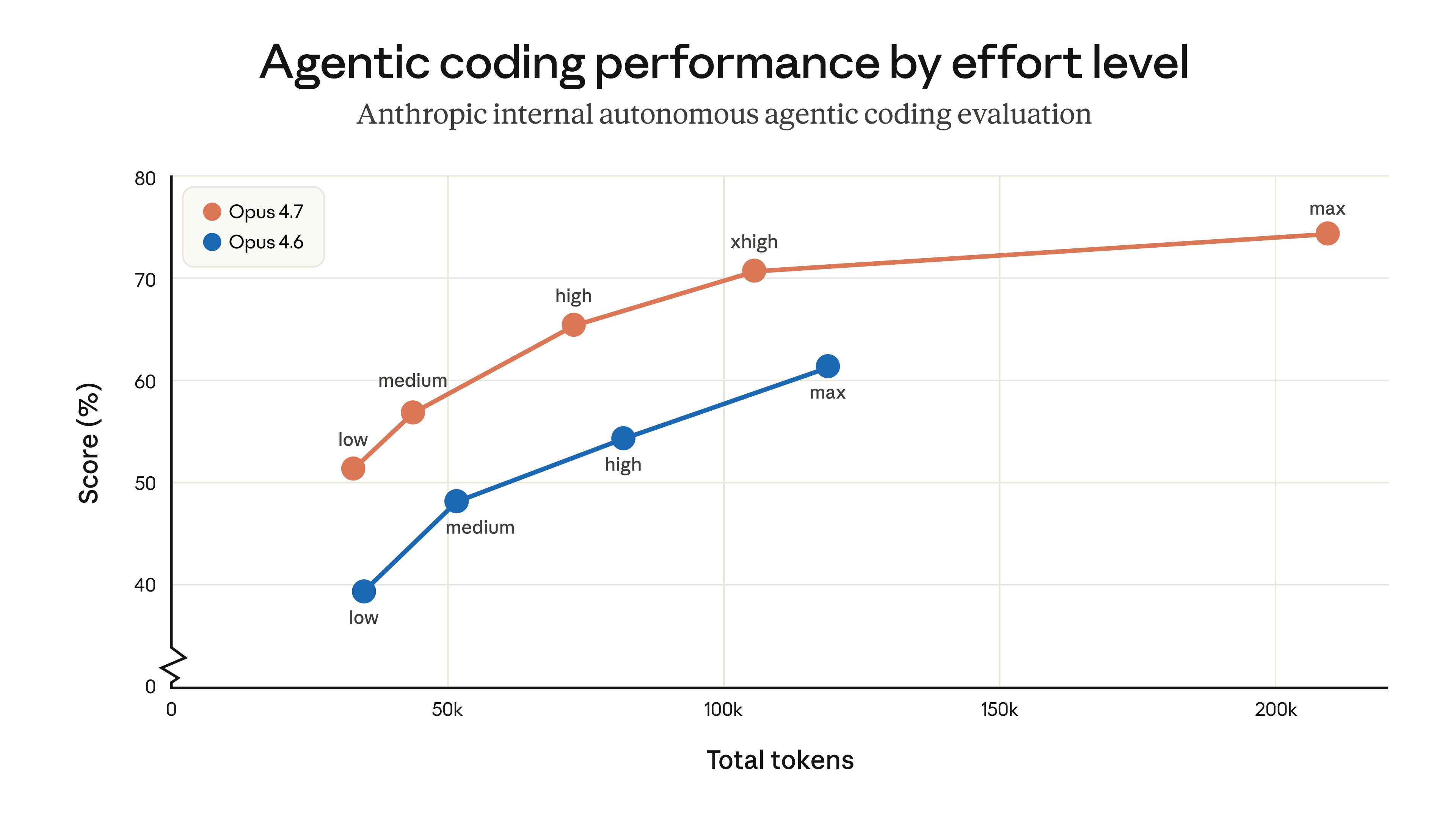
Anthropic chart of score on an internal agentic coding evaluation against total tokens at each effort level: Claude Opus 4.7 scores higher than Opus 4.6 at every level, rising from about 51% at low effort (about 33K tokens) to about 74% at max (about 210K tokens)

Agentic coding score vs. total tokens at each effort level. Anthropic, Claude Opus 4.7, Apr. 2026

Major open problems in post-training

Reasoning efficiency in RL

+ manipulating CoT efficiency, and alignment

A simple idea (partially related): What if we spend more RL compute on the hardest problems?

Recall: The popular algorithm Group Relative Policy Optimization (GRPO) generates multiple completions to the same prompts to try and create batches that have correct & incorrect answers (those have gradient).

Can we create batches dynamically around this to better allocate compute?

Major open problems in post-training

Reasoning efficiency in RL

Motivation: Common RL practices improve performance on easy problems, but not the hardest problems.
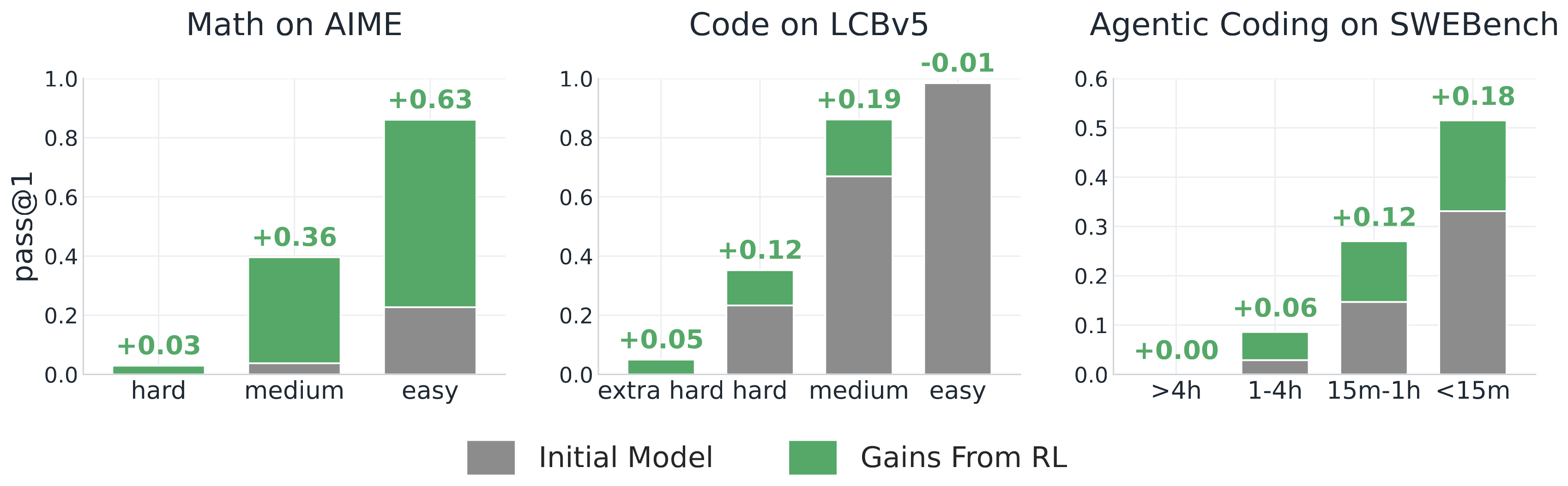
pass@1 of the initial model and gains from RL by problem difficulty on AIME math, LiveCodeBench v5, and SWE-bench: most gains are on easy problems
Major open problems in post-training

Reasoning efficiency in RL

A proposed solution: Never Give Up (NGU) – expand inference batches if all completions are incorrect, with probability p.
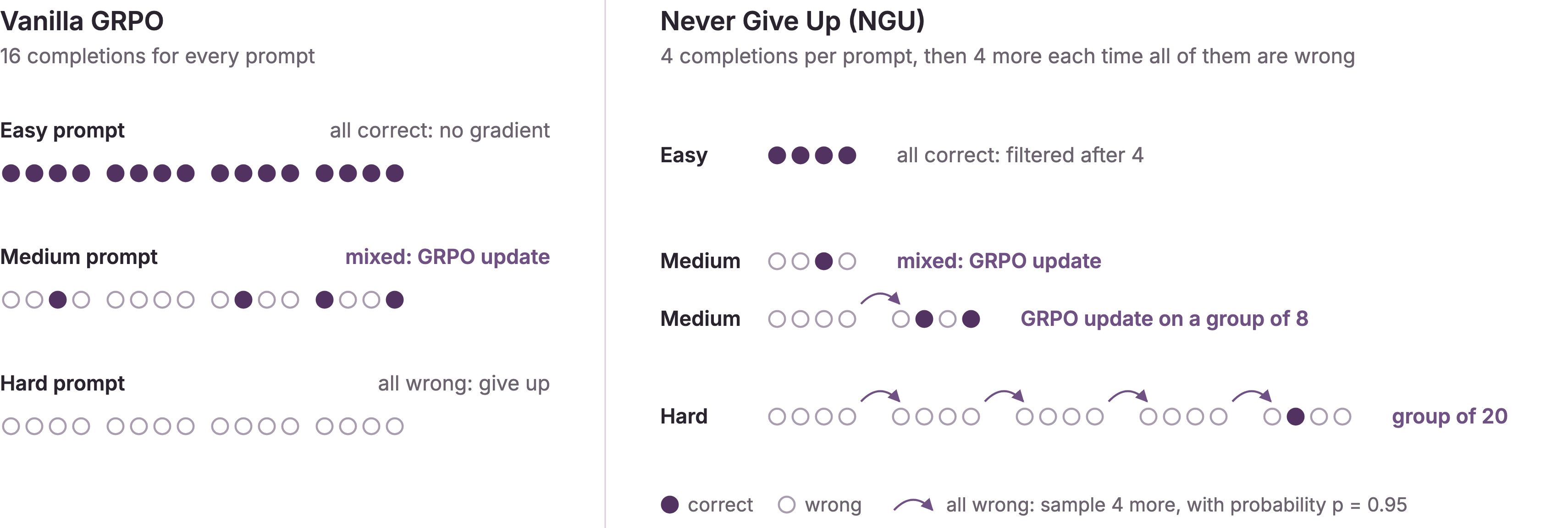
Vanilla GRPO gives every prompt 16 completions: an easy prompt is all correct and gives no gradient, a medium prompt gives an update, a hard prompt is all wrong and is given up on. Never Give Up samples 4 completions, filters the easy prompt after 4, and samples 4 more each time all are wrong, so a medium prompt updates on a group of 8 and a hard prompt on a group of 20
Major open problems in post-training

Reasoning efficiency in RL

This is one of my papers where I’ve been the most confident in the direction of the idea, but it’s very difficult to make the RL experiments fair! Shockingly hard!
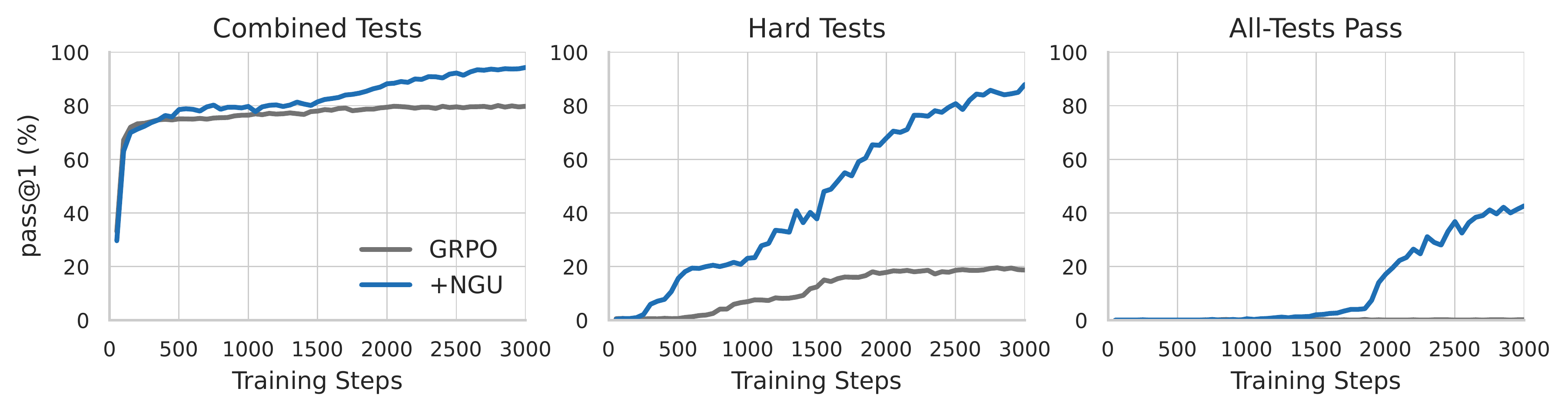
pass@1 over 3000 training steps on a coding task for GRPO and GRPO with Never Give Up, in three panels: on combined tests NGU keeps improving to about 94% while GRPO plateaus near 80%; on hard tests NGU reaches about 88% against about 19% for GRPO; on passing all of a problem's tests NGU reaches about 43% while GRPO stays at zero
Major open problems in post-training

Scaling laws for RL

+ designing methods like pretraining ladders for post-training, and RL data selection

We need to design methods for predicting performance of large post-training runs. What will the equivalent of a pretraining ladder look like for RL?
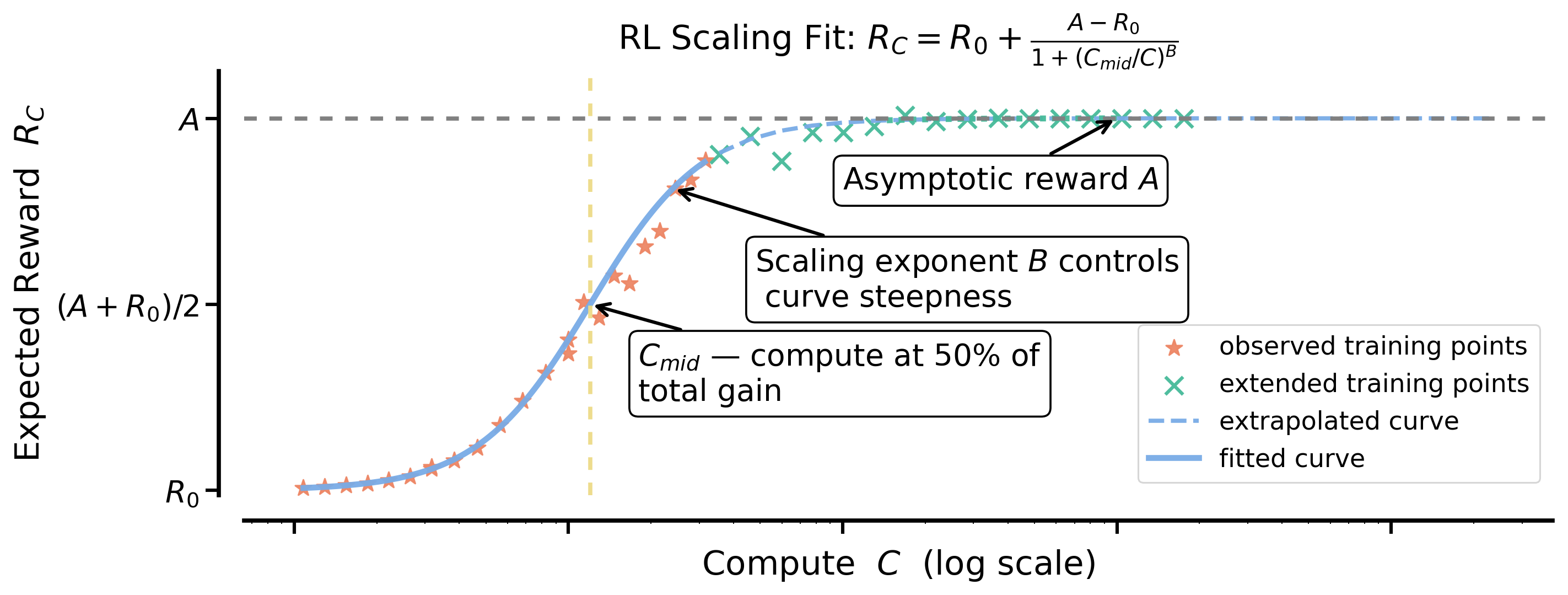
ScaleRL sigmoidal fit of expected reward against log compute, with asymptotic reward A, scaling exponent B, and the compute midpoint
Major open problems in post-training

Multi-agent scaling laws

+ evaluation of swarms, and formulations for how models collaborate reliably & efficiently

Multi-agent systems are a way to spend more on compute to:

a) make LLMs faster in wall-clock time, and

b) increase peak performance of the models on hard tasks.

Major open problems in post-training

Multi-agent scaling laws

+ evaluation of swarms, and formulations for how models collaborate reliably & efficiently

  • Which tasks benefit from a speedup in clock time?
  • How do individual models impact alignment?
  • How can model diversity be used to maximize performance?
  • How do we need to change training for multi-agent models? What is the science of sub-agents during RL?
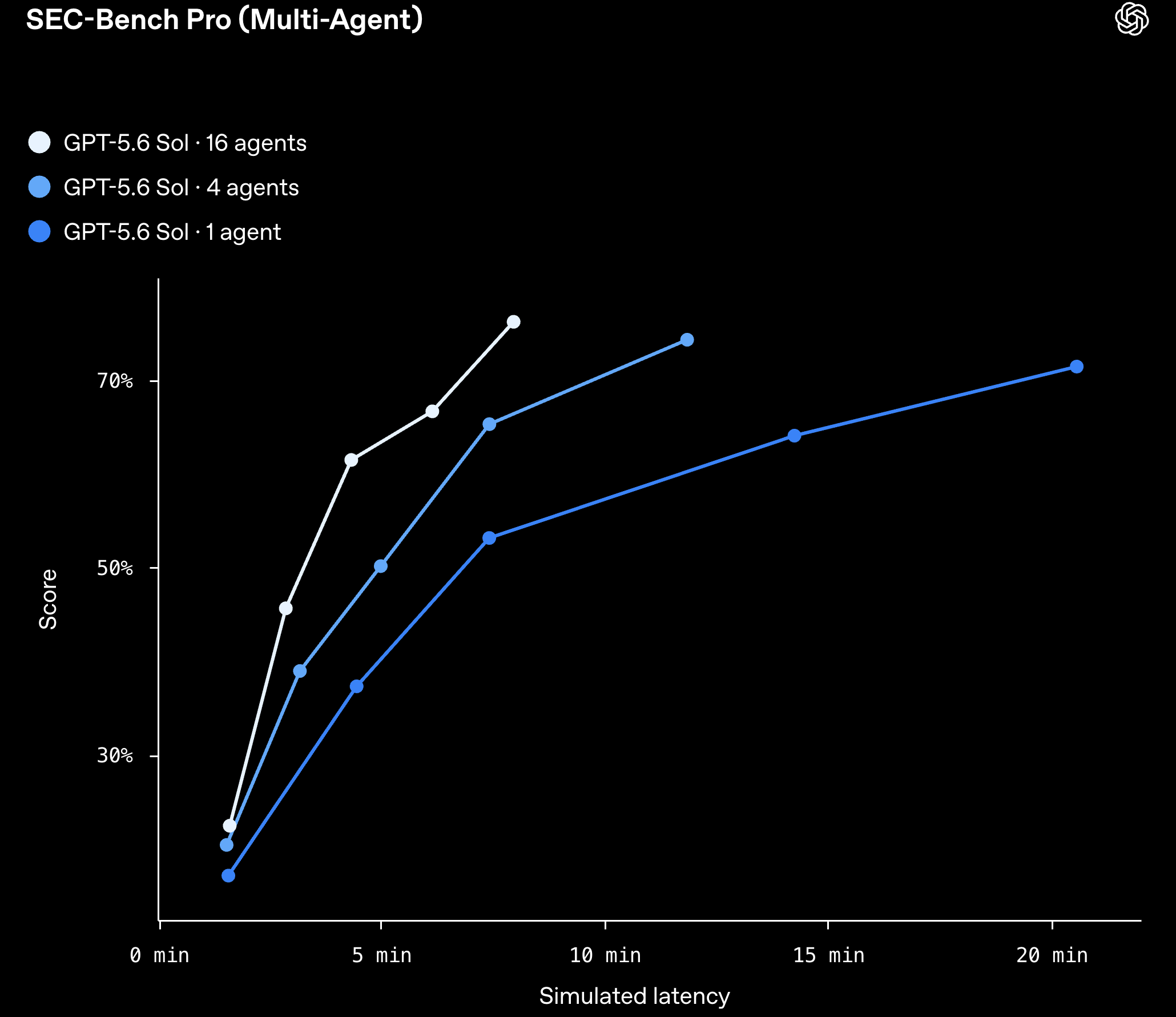
OpenAI chart of SEC-Bench Pro score against simulated latency for GPT-5.6 Sol with 1, 4, and 16 agents: more agents reach a given score sooner, and the 16-agent curve is highest at every latency

SEC-Bench Pro score vs. latency with 1, 4, and 16 agents. OpenAI, GPT-5.6, Jul. 2026

Major open problems in post-training

Multi-agent scaling laws

+ evaluation of swarms, and formulations for how models collaborate reliably & efficiently

  • Which tasks benefit from a speedup in clock time?
  • How do individual models impact alignment?
  • How can model diversity be used to maximize performance?
  • How do we need to change training for multi-agent models? What is the science of sub-agents during RL?
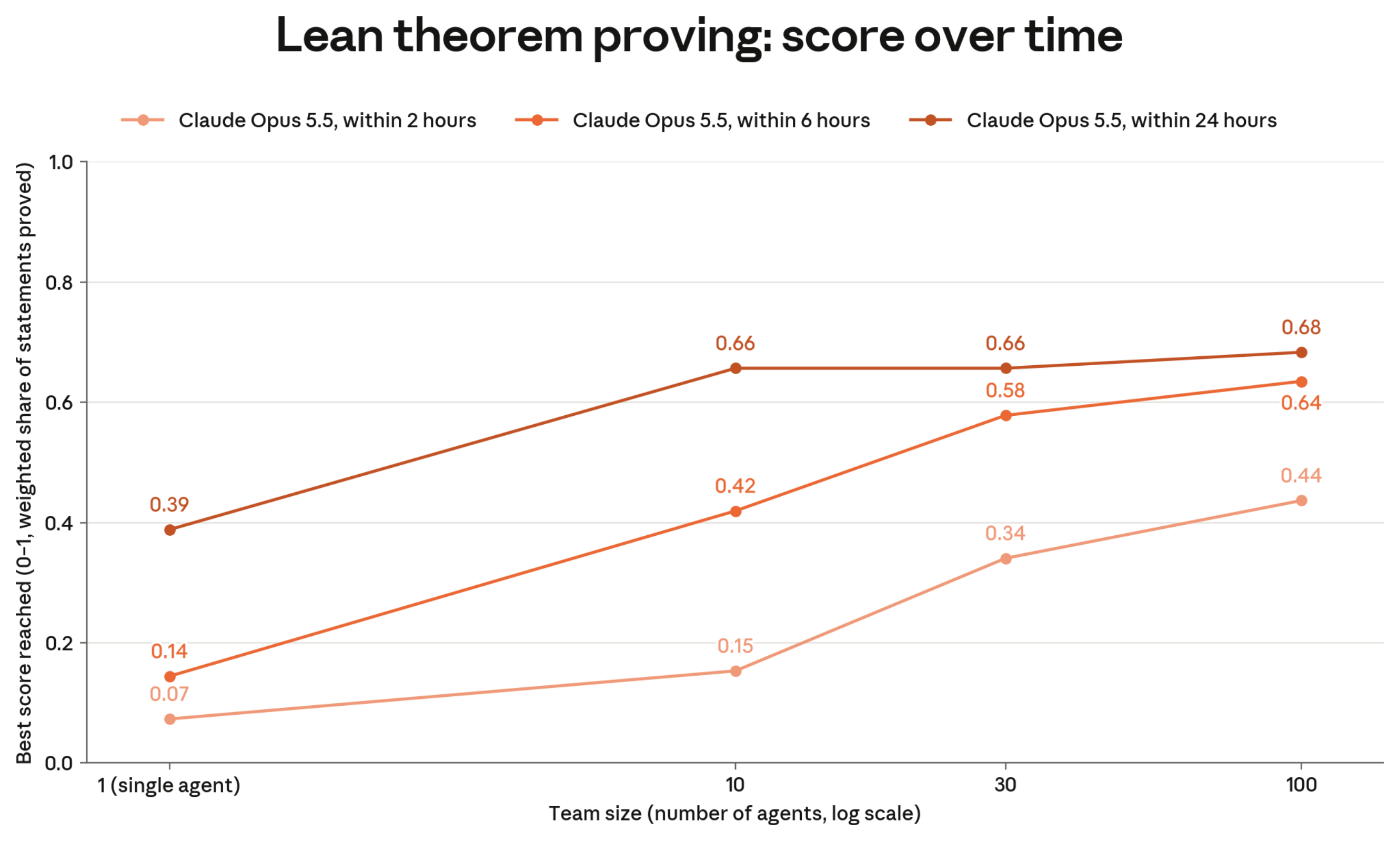
Anthropic chart of Lean theorem proving score for Claude Opus 5.5 teams of 1, 10, 30, and 100 agents, within 2, 6, and 24 hours: larger teams reach a given score much earlier, and the 24-hour scores level off at about 0.66 to 0.68 from 10 agents up

Lean theorem proving: best score within 2, 6, and 24 hours, by team size. Anthropic, Claude Opus 5.5 system card, Sep. 2026

Major open problems in post-training

  • Harness specialization and design – How do we design environments for context management that enable new paradigms of using LLMs?
  • Character training – How do we create the personality of models and how does this impact safety, trust, and diffusion of LLMs?
  • Open-source RL environments – How do we create scalable, open data methods?
  • Reasoning efficiency in RL – How do we control and manipulate the reasoning efficiency of LLMs?
  • Scaling laws for RL – How do we design principled experimentation methodology for large-scale post-training?
  • Multi-agent scaling laws – What are the main axes of inquiry into multi-LLM systems and collaborations?

Part 3: RSI, the nature of academic research, & conclusions

A common worry I hear in the face of rapid progress

RSI: Recursive Self-Improvement – using AI models to increasingly automate and accelerate AI research / model building.

I constantly hear variants of:

  • Should I still do a Ph.D.?
  • What is the role of research?
  • What is the point?

An example plot that sparks concern

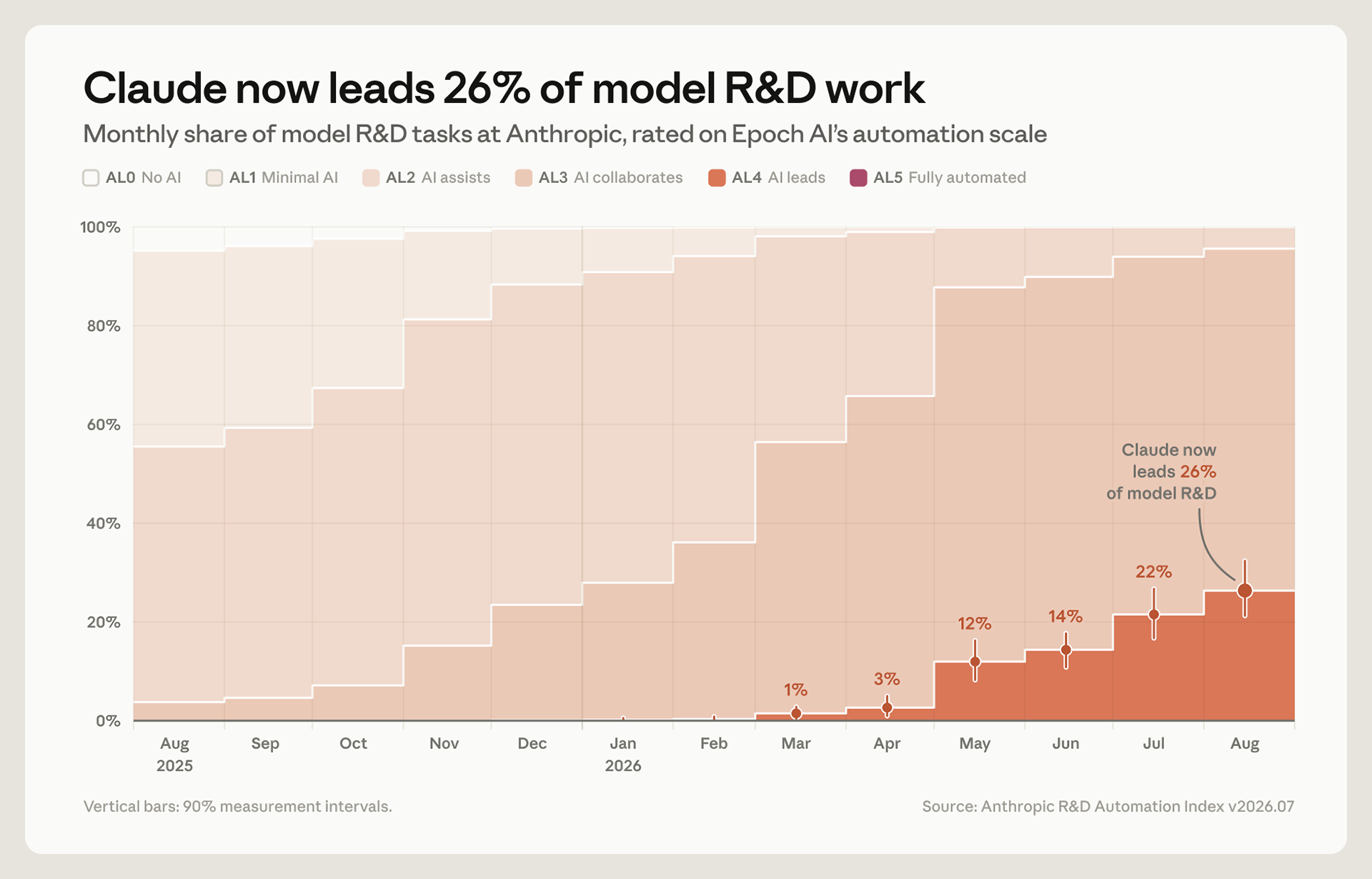
Anthropic R&D Automation Index: monthly share of model R&D tasks at Anthropic by automation level, Aug. 2025 to Aug. 2026. The share where Claude leads (AL4) rises from under 1% in Feb. 2026 to 26% in Aug. 2026; no work is fully automated (AL5)

Share of Anthropic's model R&D tasks at each automation level, Aug. 2025 to Aug. 2026. Anthropic, Nov. 2026

What does it mean for an LLM to lead most R&D work?

Is this measured by time spent?

Is this measured by percent of code written or experiments run?

To use a Claude-ism, the load-bearing piece of work may be a very small proportion of the overall process.

Researchers are trained for and valued for that small, insightful piece of work.

Anthropic R&D Automation Index: monthly share of model R&D tasks at Anthropic by automation level, Aug. 2025 to Aug. 2026. The share where Claude leads (AL4) rises from under 1% in Feb. 2026 to 26% in Aug. 2026; no work is fully automated (AL5)

Share of Anthropic's model R&D tasks at each automation level, Aug. 2025 to Aug. 2026. Anthropic, Nov. 2026

Using LLMs accelerates output but very minimally accelerates understanding

More of science shifts to problem formulation, understanding “impact”, communication, standard setting, consensus building, mentorship, etc.

For senior scientists: I barely write code anymore, but I’m busier than ever as a scientist. LLMs are clearly very empowering.

For junior scientists: Doing inefficient work manually is often the only way to build understanding. Training could take longer, with more work feeling like “homework” rather than productive output.

Examples of work that would be WAY faster: Zephyr β & Tülu 2

In 2023, it took a long time for clear, almost obvious, ideas to be used in strong models! In this era, the goal was to match performance of closed models on “chat” evals with minimal finetuning.

  • Direct Preference Optimization (DPO) paper was released in May 2023 (Rafailov et al., 2023)
  • Zephyr β (Oct 2023) and Tülu 2 (Nov 2023) were released later, even though everyone was trying it.
    • Fun fact: Chris Manning thanked me for “saving” DPO with these two models.
  • Both these models came after a research dataset, UltraFeedback (Cui et al., 2023), was released in Oct 2023
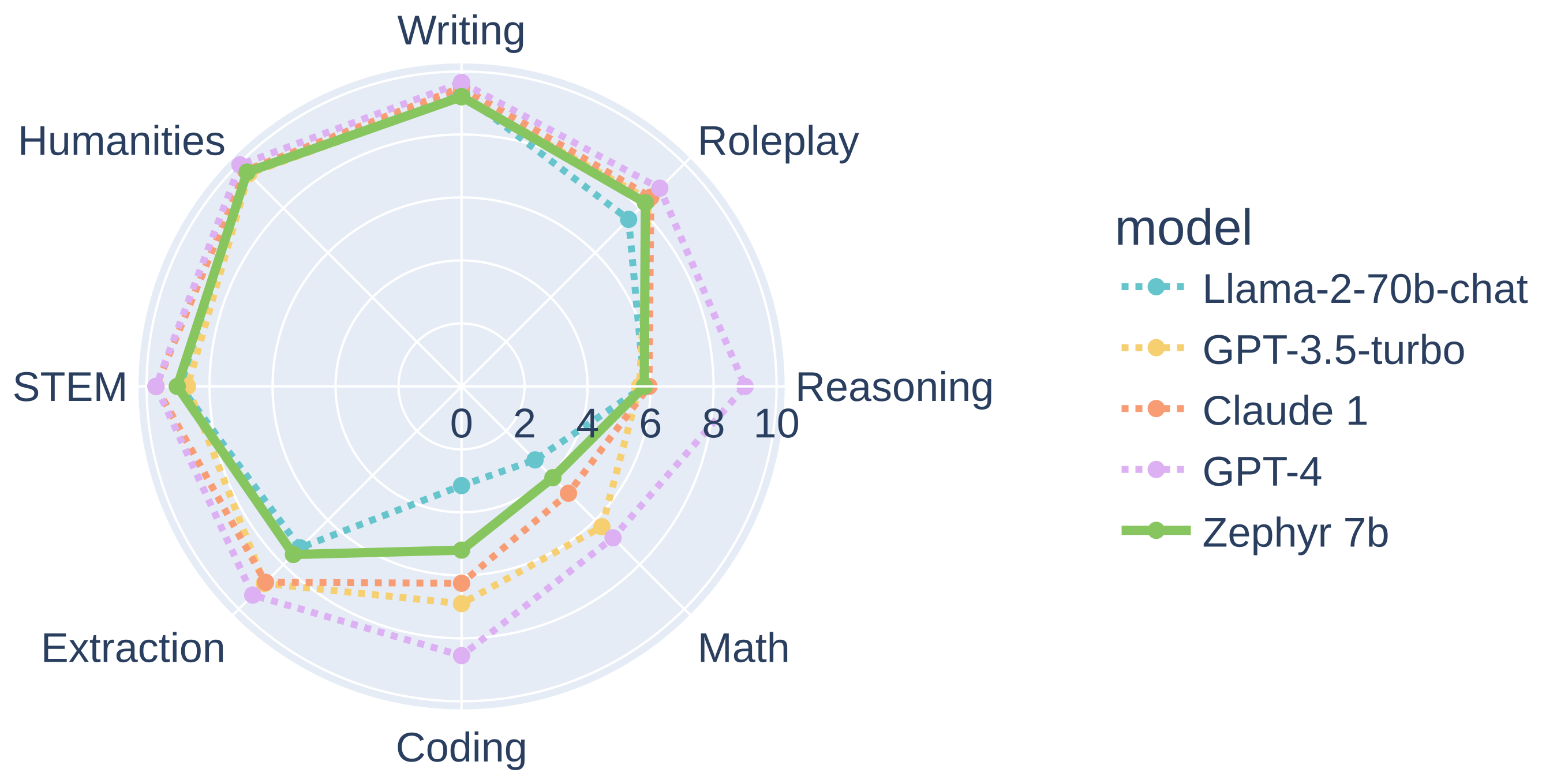
MT-Bench scores by category for Zephyr 7B, Llama 2 70B chat, GPT-3.5 Turbo, Claude 1, and GPT-4

MT-Bench by category (Tunstall et al., 2024)

Examples of work that would be WAY faster: RewardBench & the original Olmo post-training

RewardBench: Building the first evaluation for reward models used in RLHF.

  • Knew it was important: summer of 2023
  • Started full-time: Oct 2023
  • Published: Mar 2024

Would expect this to take ~1/2 to 1/4 of the time now.

Olmo: In the first Olmo, the post-training was incredibly minimal, mostly the Tülu 2 recipe, added almost as an afterthought. Early in 2024, building a language model was way more about pretraining… can figure out how to “align” it later.

Models can do this “apply known solution” work fairly well.

The Ai2 OLMo logo from the first release in 2024

Work that’s far less changed: Tülu 3, Olmo 2 & 3

  • The nuggets of work at Olmo and in the top end of academia on training and data are not meaningfully different from the frontier labs.
  • The organizational complexity of rapidly building and releasing frontier LLMs is extremely complex. We had scaled to the limits of this complexity at Olmo. There are tons of stages, and complexity has only been increasing post-training across domains, infrastructure, etc.
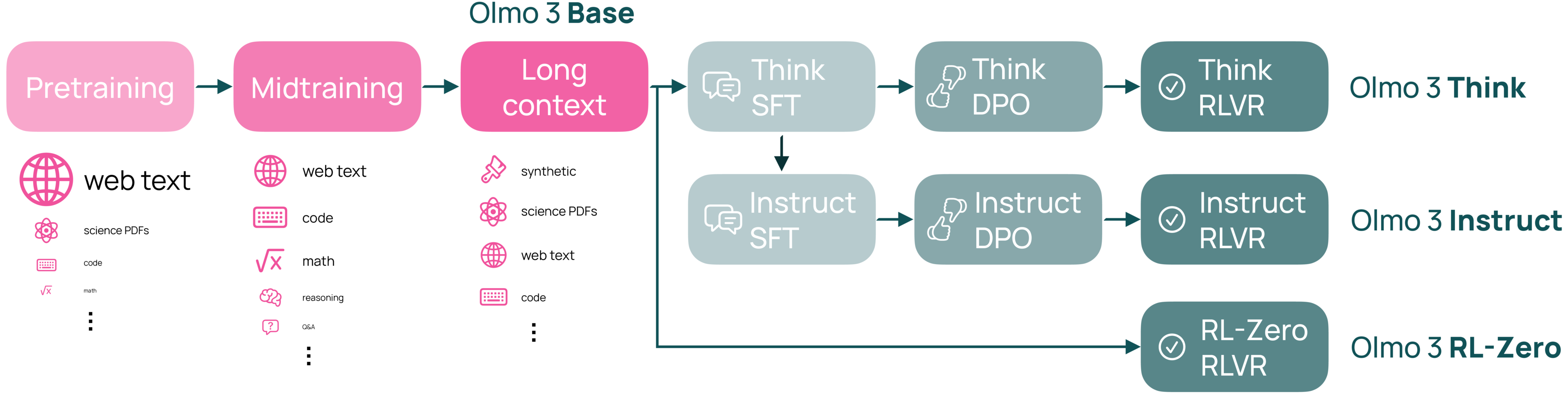
Olmo 3 model flow: pretraining, midtraining, and long context produce Olmo 3 Base; Think, Instruct, and RL-Zero branches each run SFT, DPO, and RLVR

Olmo 3 model flow (Olmo et al., 2025)

At Trillium Labs we aim to solve the open post-training problems and help the scientific community transition to the new era of AI research

The goals we have in building new research infrastructure & recipes:

  • Establish an area of study (e.g. empirical character training in RL)
  • Establish the language used to understand something (e.g. RLVR with Tülu 3)
  • Build datasets, or models, that are re-used (e.g. enable AI safety non-profits)
  • Change how people think about a problem facing LLMs (likely the hardest)

Thanks for listening! Questions?

Slides: natolambert.com/cornell-2026

Newsletter: interconnects.ai

Book: rlhfbook.com

Trillium Labs: trilliumlabs.org

We’re hiring: full-time MTS, student researchers, and interns

Contact: nathan@natolambert.com

References (1/4)

Cui, G., Yuan, L., Ding, N., Yao, G., Zhu, W., et al. “UltraFeedback: Boosting Language Models with High-quality Feedback.” arXiv preprint arXiv:2310.01377, 2023. [link]
DeepSeek-AI. “DeepSeek-V3 Technical Report.” 2025. [link]
Devlin, J., Chang, M., Lee, K., and Toutanova, K. “BERT: Pre-training of Deep Bidirectional Transformers for Language Understanding.” arXiv preprint arXiv:1810.04805, 2018. [link]
Groeneveld, D., Beltagy, I., Walsh, P., Bhagia, A., Kinney, R., et al. “OLMo: Accelerating the Science of Language Models.” Proceedings of the 62nd Annual Meeting of the Association for Computational Linguistics, 2024. [link]
Guo, D., Yang, D., Zhang, H., Song, J., Zhang, R., et al. “Deepseek-r1: Incentivizing reasoning capability in llms via reinforcement learning.” arXiv preprint arXiv:2501.12948, 2025.
Guo, D., Yang, D., Zhang, H., and others. “DeepSeek-R1 incentivizes reasoning in LLMs through reinforcement learning.” Nature, 2025.
Ivison, H., Wang, Y., Pyatkin, V., Lambert, N., Peters, M., et al. “Camels in a Changing Climate: Enhancing LM Adaptation with Tülu 2.” arXiv preprint arXiv:2311.10702, 2023.
Ivison, H., Yin, J., Shao, R., Xiao, T., Lambert, N., et al. “TMax: A Simple Recipe for Terminal Agents.” arXiv preprint arXiv:2606.23321, 2026. [link]

References (2/4)

Khatri, D., Madaan, L., Tiwari, R., Bansal, R., Duvvuri, S., et al. “The art of scaling reinforcement learning compute for llms.” arXiv preprint arXiv:2510.13786, 2025.
Lambert, N., Morrison, J., Pyatkin, V., Huang, S., Ivison, H., et al. “Tülu 3: Pushing Frontiers in Open Language Model Post-Training.” arXiv preprint arXiv:2411.15124, 2024.
Lambert, N., Pyatkin, V., Morrison, J., Miranda, L., Lin, B., et al. “RewardBench: Evaluating reward models for language modeling.” Conference of the North American Chapter of the Association for Computational Linguistics, 2025.
Maiya, S., Bartsch, H., Lambert, N., and Hubinger, E. “Open Character Training: Shaping the Persona of AI Assistants through Constitutional AI.” arXiv preprint arXiv:2511.01689, 2025.
Malik, S., Pyatkin, V., Land, S., Morrison, J., Smith, N., et al. “RewardBench 2: Advancing Reward Model Evaluation.” arXiv preprint arXiv:2506.01937, 2025.
Merrill, W., Li, Y., Romero, T., Svete, A., Costello, C., et al. “Olmo Hybrid: From Theory to Practice and Back.” 2026. [link]
Muennighoff, N., Soldaini, L., Groeneveld, D., Lo, K., Morrison, J., et al. “OLMoE: Open Mixture-of-Experts Language Models.” International Conference on Learning Representations, 2025. [link]
Noukhovitch, M., Ivison, H., Lambert, N., and Courville, A. “Learning to Solve Hard Problems in RL for LLMs by Never Giving Up.” 2026. [link]

References (3/4)

OLMo, T., Walsh, P., Soldaini, L., Groeneveld, D., Lo, K., et al. “2 OLMo 2 Furious.” arXiv preprint arXiv:2501.00656, 2024.
Olmo, T., Ettinger, A., Bertsch, A., Kuehl, B., Graham, D., et al. “Olmo 3.” 2025. [link]
Ouyang, L., Wu, J., Jiang, X., Almeida, D., Wainwright, C., et al. “Training language models to follow instructions with human feedback.” Advances in neural information processing systems, 2022.
Radford, A., Narasimhan, K., Salimans, T., and Sutskever, I. “Improving Language Understanding by Generative Pre-Training.” 2018. [link]
Rafailov, R., Sharma, A., Mitchell, E., Manning, C., Ermon, S., et al. “Direct preference optimization: Your language model is secretly a reward model.” Advances in Neural Information Processing Systems, 2023.
Raffel, C., Shazeer, N., Roberts, A., Lee, K., Narang, S., et al. “Exploring the limits of transfer learning with a unified text-to-text transformer.” Journal of machine learning research, 2020.
Shao, R., Shen, S., Yin, J., Li, Y., Wang, M., et al. “Context Language Models.” 2026. [link]
Tunstall, L., Beeching, E., Lambert, N., Rajani, N., Rasul, K., et al. “Zephyr: Direct Distillation of LM Alignment.” First Conference on Language Modeling, 2024.

References (4/4)

Wei, J., Bosma, M., Zhao, V., Guu, K., Yu, A., et al. “Finetuned Language Models are Zero-Shot Learners.” International Conference on Learning Representations, 2022. [link]
Xiaomi LLM-Core Team, Xiao, B., Xia, B., Yang, B., Gao, B., et al. “MiMo-V2-Flash Technical Report.” 2026. [link]

Extra slides

OpenAI: estimated AI R&D tasks per researcher
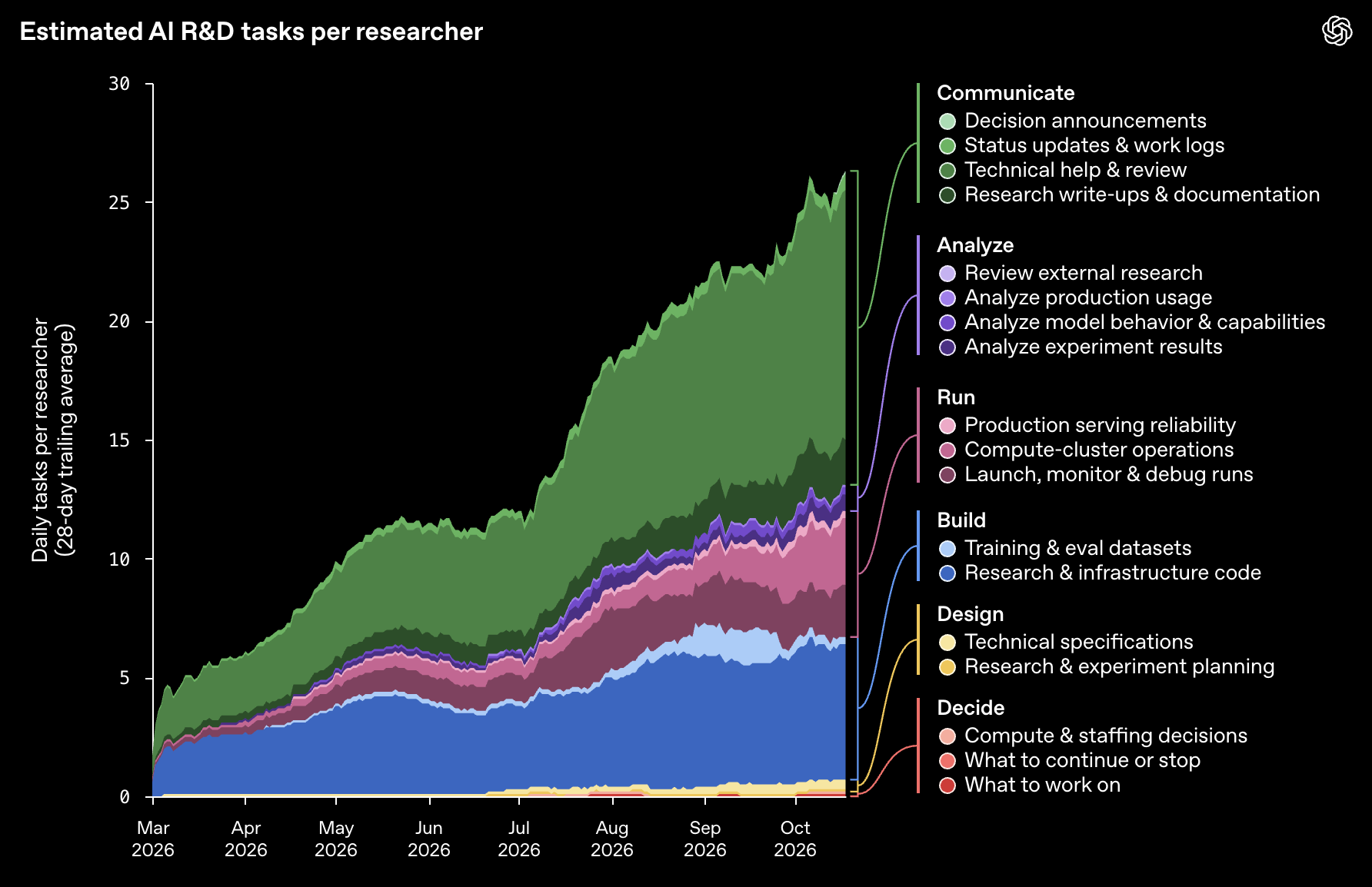
OpenAI chart of estimated daily AI R&D tasks per researcher, 28-day trailing average, Mar. to Oct. 2026, rising from about 2 to about 26. Communicate tasks (status updates and work logs) and Build tasks (research and infrastructure code) are the largest shares; Design and Decide tasks stay near zero

Estimated daily AI R&D tasks per researcher at OpenAI by type of work, Mar. to Oct. 2026. OpenAI, Nov. 2026

Where finetuning came from

Pretraining a model and then finetuning it was standard practice in computer vision before it took over NLP.

  • 2018, GPT-1 and BERT: pretrain a language model on unlabeled text, then finetune it on each task (Radford et al., 2018) (Devlin et al., 2018)
  • 2019, T5: every task cast as text-to-text, so the same model, objective, and decoding apply to all of them (Raffel et al., 2020)
  • 2021, FLAN: instruction tuning, where finetuning on many tasks written as instructions improves zero-shot performance on unseen tasks (Wei et al., 2022)